Dental insurance verification services
Dental Revenue Desk is an outsourced dental insurance verification service for US dental practices. Dental Revenue Desk verifies each scheduled patient's coverage, completes a full benefits breakdown across 30 published fields — maximums, deductibles, category percentages, waiting periods, frequency limitations, coordination of benefits — and writes it back into your practice management system 3–5 days before the appointment.
Dental Revenue Desk publishes no service credit for a missed window as of July 2026; the turnaround terms and daily cutoffs are set out inthe seven-step daily verification cycle.
Published July 21, 2026
What a Dental Revenue Desk verification completes for every patient
Dental Revenue Desk treats dental insurance verification as one question answered before appointment day: exactly what will this patient's plan pay for the treatment on the schedule?
For every insured patient on your schedule, Dental Revenue Desk verifies the plan through the carrier portal, verifies the fields a carrier portal cannot answer by calling the carrier, and writes back the finished breakdown into your practice management system — so your front desk opens the chart and the answer is already there.
- Every insured patient on the schedule — not a sampled subset
- Portal verification plus carrier calls where portals fall short
- Every completed verification passes QA review before write-back
- Patient
- Jane Sample (subscriber)
- Carrier / plan
- Sample Dental PPO — Group #00000
- Appointment
- Verified 4 days ahead
- Eligibility status
- Active · eff. 01/01/2026
- Annual maximum
- $1,500 · $1,102 remaining
- Deductible
- $50 · met
- Preventive / Basic / Major
- 100% / 80% / 50%
- Waiting periods
- None on file
- Frequency — prophylaxis
- 2 per 12 months · 1 used
Every value above is synthetic. Real breakdowns are written back into your practice management system — never emailed.
The 30 fields in the full benefits breakdown
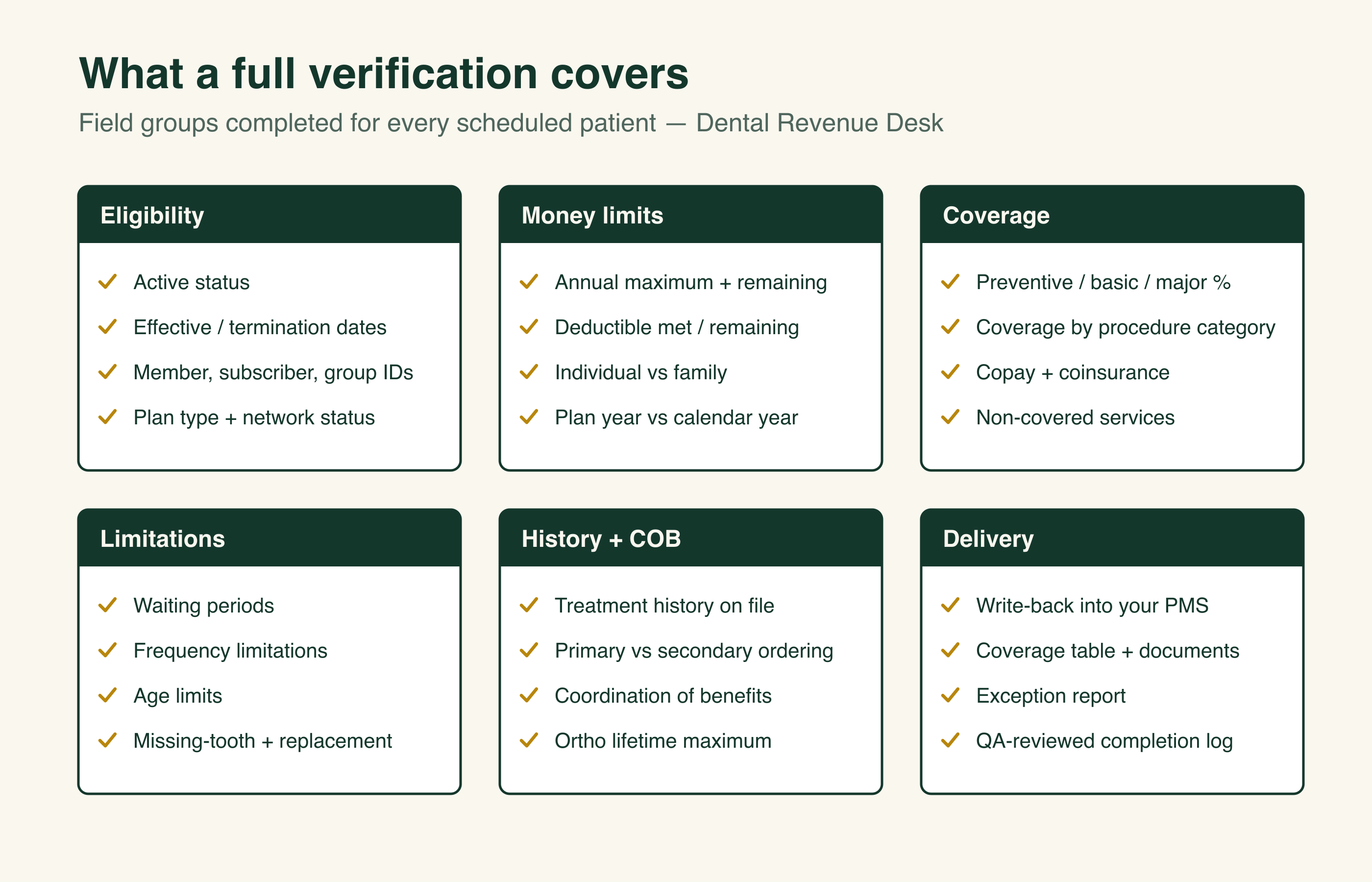
This table is Dental Revenue Desk's published scope for one verification — one completed verification attempt for one scheduled patient. Every plan gets every field attempted; anything a carrier cannot confirm is flagged in the exception report rather than left blank. The six groups are not a menu: Dental Revenue Desk attempts all 30 fields on every plan and records which of them the carrier answered.
| Field group | Fields verified |
|---|---|
| Eligibility & identity | Active coverage status · Effective date · Termination date · Member + subscriber IDs · Group number |
| Plan structure | Plan type (PPO / DHMO / indemnity) · Calendar-year vs plan-year · In-network vs out-of-network status · Subscriber vs dependent relationship · Primary vs secondary ordering |
| Money limits | Annual maximum · Remaining annual maximum · Individual deductible — met and remaining · Family deductible — met and remaining · Copay and coinsurance amounts |
| Coverage | Preventive coverage percentage · Basic coverage percentage · Major coverage percentage · Orthodontic coverage + lifetime maximum · Non-covered services |
| Limitations & clauses | Waiting periods · Frequency limitations · Age limitations · Missing-tooth clause · Replacement limitations |
| History & provisions | Treatment history where available · Alternate benefit / LEAT provisions · Downgrade provisions · Bundling and downcoding flags · Coordination of benefits method |
To see how those 30 fields read on the page a front desk actually works from, Dental Revenue Desk publishes a completed breakdown for one patient.
Eligibility check vs full verification — and why the difference decides the estimate
Eligibility, used precisely, means one thing: confirmation that a plan is active for that patient on that date. It is a subset of a verification, not another word for one. The industry's machine path for that subset is the automated eligibility response — the ASC X12N 270/271 transaction, the HIPAA standard the2024 CAQH Index Reportnames for eligibility and benefit verification. That path is already the dental norm: the report puts dental eligibility and benefit verification transaction volume, as reported by dental plans, at 82% fully electronic, 15% partially electronic and 3% fully manual for calendar year 2023.
So the open question is not whether the machine answers — it is what the answer contains. Mark A. Moats, D.M.D., chair of the ADA Council on Dental Benefit Programs, toldADA News in March 2025that "providers indicated in the CAQH Index that they often do not obtain robust enough information through the automated transaction to be reliable. These limitations have led to continued reliance on plan portals for verification." A dental practice quoted in the same Index: "When it comes to eligibility and benefits, I don't have an automated tool that I can trust, so I don't use it."
Depth is also where denial risk sits. Optum's2024 Revenue Cycle Denials Index— 124 million hospital claim remits from more than 1,400 US hospitals, calendar year 2023, hospital rather than dental data — splits registration-and-eligibility denials into coordination of benefits 50%, benefit maximum 27%, plan coverage 17% and patient eligibility 6%. No national dental denial benchmark exists to quote, and Dental Revenue Desk will not invent one. Dental Revenue Desk completes all 30 fields, not the active-coverage subset, because the estimate your front desk quotes is built from the other 29.
How the finished breakdown reaches your software
Dental Revenue Desk writes back the finished breakdown into your practice management system by keyed entry — a named team member working inside your system, under the scoped access your administrator provisions, entering the coverage table, the benefit notes and the supporting documentation where treatment plans and estimates are built.
Dental Revenue Desk's delivery model is write-back into your system, not an emailed attachment your team re-keys, and it happens by keyed entry rather than by API. Which of the 30 fields a given system has a field for differs by system, and each vendor documents its own limits: what Dentrix, Open Dental and Eaglesoft publish about write-back.
When a plan cannot be fully verified
Dental Revenue Desk does not leave a field blank for the front desk to discover. Some plans resist verification: a carrier's hold queue runs long, a portal omits treatment history, an employer's records lag a termination. Every unresolved field is flagged in the exception report with what was confirmed, what is missing, and what needs a practice decision, and it stays in the exception queue until it is resolved.
Every completed verification passes QA review before write-back, and Dental Revenue Desk records every completed verification in the completion log your practice can audit.
What a Dental Revenue Desk verification does not include
Dental Revenue Desk publishes its verification exclusions, because scope you only discover after signing is not scope. Six things are outside one verification.
- Predeterminations — theADA Glossary of Dental Administrative Termsdefines one as "a process where a dentist submits a treatment plan to the payer before treatment begins." Dental Revenue Desk does not submit them today; it is a roadmap service, not a live one.
- Preauthorizations and precertifications — the same ADA glossary defines preauthorization as a payer "statement … indicating that proposed treatment will be covered under the terms of the benefit contract." Neither it nor precertification is part of a Dental Revenue Desk verification.
- Patient benefit-explanation calls — Dental Revenue Desk does not speak to your patients.
- Treatment-plan estimating — the Dental Revenue Desk breakdown is the input your estimate is built from; Dental Revenue Desk does not build the estimate or set the patient portion.
- Claim submission, attachments, appeals and payment posting — separate Dental Revenue Desk engagements, scoped and quoted on their own.
- The date-of-service eligibility re-check — Dental Revenue Desk completes the breakdown 3–5 days before the appointment, and theADA's eligibility verification guidancestates "it is essential that dental offices verify eligibility on the date of service to avoid recoupment requests in the future," because plans can change eligibility retroactively. That re-check stays with your front desk, and CMS sets the ceiling on every method: "an eligibility response from a health plan does not guarantee that the health plan will reimburse the provider for health services when a claim is submitted."
Who this is for — and who it is not for
Practices that outsource dental insurance verification to Dental Revenue Desk are US dental practices with one to five locations — solo offices, multi-provider general practices and small groups — carrying a meaningful insured-patient mix. Dental Revenue Desk scopes the engagement around four situations a practice may be in: coordinator turnover, growing appointment volume, plan-year reset season, or a standing backlog of unverified appointments. Insurance verification for dental practices is the whole of the entry engagement.
Dental Revenue Desk is the wrong choice for six kinds of practice.
- Practices requiring all PHI access from US-based staff. The Dental Revenue Desk delivery team is Pakistan-based, and Dental Revenue Desk discloses that access geography in writing.
- Practices wanting only date-of-service verification with no advance cycle. Dental Revenue Desk prices urgent same-day verification at $10–$15 per verification as an add-on, not as the model.
- Practices that cannot provision scoped, named-user access to a practice management system for an outside business associate.
- Practices wanting patient-facing financial conversations, treatment-plan estimates or predeterminations handled for them.
- Groups larger than five locations, who get a scoped conversation rather than the published plan bands.
- Practices shopping for software to run themselves. Dental Revenue Desk is a service, not software — people completing the work inside your system.
What a dental insurance verification company should publish before you sign
Buying decisions here turn on published terms, not adjectives. Dental Revenue Desk publishes six of them, and a practice comparing dental insurance verification companies — or generalist insurance verification services, or any third party dental insurance verification vendor — can ask for the same six in writing before signing.
- Field-level scope — the 30 fields Dental Revenue Desk attempts on every plan, named individually
- Verification exclusions — the six things a Dental Revenue Desk verification does not include
- Write-back at field level, system by system, and whether it is by keyed entry or by API
- The turnaround window, the daily cutoff, and whether a missed window carries any remedy
- Numeric pricing, and what counts as one verification
- The security order of operations — the BAA signed before any PHI access — and, in writing, where the people doing the work sit
What Dental Revenue Desk will not publish matters as much: no accuracy percentage, no collection-rate claim, no reviews, no operating statistics — Dental Revenue Desk is pre-launch and will not manufacture the evidence. That isour published claims policy.
What Dental Revenue Desk verification costs
Dental Revenue Desk plans start at $499/month for up to 50 verifications. Dental Revenue Desk publishes every band, the urgent add-on and what counts as one verification onverification plans and monthly pricing.
Published 21 July 2026. Scope, exclusions and pricing on this page are Dental Revenue Desk policy, not measured results.
Frequently asked questions
Is this an eligibility check or a full verification?
Dental Revenue Desk completes a full verification. Eligibility means only that a plan is active on a date; the Dental Revenue Desk breakdown completes 30 published fields per patient and writes them into your practice management system.
How does verified information get into our software?
Dental Revenue Desk writes the finished breakdown back into your practice management system by keyed entry, under access your administrator provisions. Nothing arrives as an email attachment your team re-keys.
What happens when a carrier portal is missing data?
Dental Revenue Desk calls the carrier. Fields a carrier portal cannot answer are verified by phone where possible; anything still unresolved is flagged in the exception report.
How far ahead of the appointment are patients verified?
Dental Revenue Desk completes the verification 3–5 days before the appointment as standard. For walk-ins and late schedule changes, Dental Revenue Desk prices urgent same-day verification at $10–$15 per verification.
Does this replace our insurance coordinator?
Dental Revenue Desk can start on backlog or overflow only, while your coordinator stays on patient-facing work. Dental insurance verification outsourcing is a scope decision before it is a staffing one.
What do we need to provide to start?
A signed agreement and a business associate agreement come first. Your administrator then provisions scoped, named-user access to your practice management system, and Dental Revenue Desk works from your schedule.
Is Dental Revenue Desk a dental insurance verification company or a dental billing company?
Dental Revenue Desk is a dental insurance verification company first. Verification is the only work in the published plans; billing, claims management and accounts-receivable follow-up are separate Dental Revenue Desk engagements.
See how verification would run in your practice
A 20-minute workflow review: we map your current verification process, show you the breakdown we deliver, and confirm your software and volume. No commitment, no patient information.